
Towards Learning Foundation Models for Heuristic Functions to Solve Pathfinding Problems
Published in GenPlan Workshop, AAAI 2025, 2025
DeepCubeAF is a reinforcement learning foundation model that learns transferable heuristic functions for pathfinding across diverse PDDL domains without relying on optimal-label supervision.
Why it matters
- Existing DRL-based heuristic learners require retraining for small domain changes, leading to high compute and time costs.
- Supervised approaches (for example, GOOSE) require optimal solution labels, which are not always obtainable for complex pathfinding domains.
- Domain-independent planners (for example, Fast Downward with FF heuristic) can struggle on complex or randomized domains.
- There is a need for a foundation model for heuristic functions that generalizes across diverse PDDL domains without assuming supervised labels.
- Training on limited domains restricts generalization; broader domain diversity may improve robustness.
What we did
- Introduced DeepCubeAF, a reinforcement learning based foundation model for learning heuristic functions across pathfinding domains.
- Used PDDLFUSE to generate diverse, randomized PDDL domains for training.
- Applied hindsight experience replay (HER) to generate additional goal states and increase training data.
- Represented planning problems as STRIPS Learning Graphs (SLGs) and trained a 16-layer GNN heuristic via approximate value iteration.
- Trained for 1 million iterations (batch size 1000) and solved problems using batch weighted A* (batch size 100, weight 0.8).
- Achieved higher coverage than GOOSE across all eight evaluated domains and solved 60% of instances on the unseen folding domain (vs. 38% for GOOSE and Fast Downward).
How it works
- Domain generation: PDDLFUSE fuses and randomizes PDDL domains to create diverse training environments.
- Goal augmentation: Hindsight experience replay (HER) generates additional goals from intermediate states.
- Graph encoding: each (state, goal, domain) tuple is represented as a STRIPS Learning Graph (SLG).
- Heuristic learning: a 16-layer message-passing GNN is trained with approximate value iteration loss.
- Search: batch weighted A* (batch size 100, weight 0.8) uses the learned heuristic for solving.
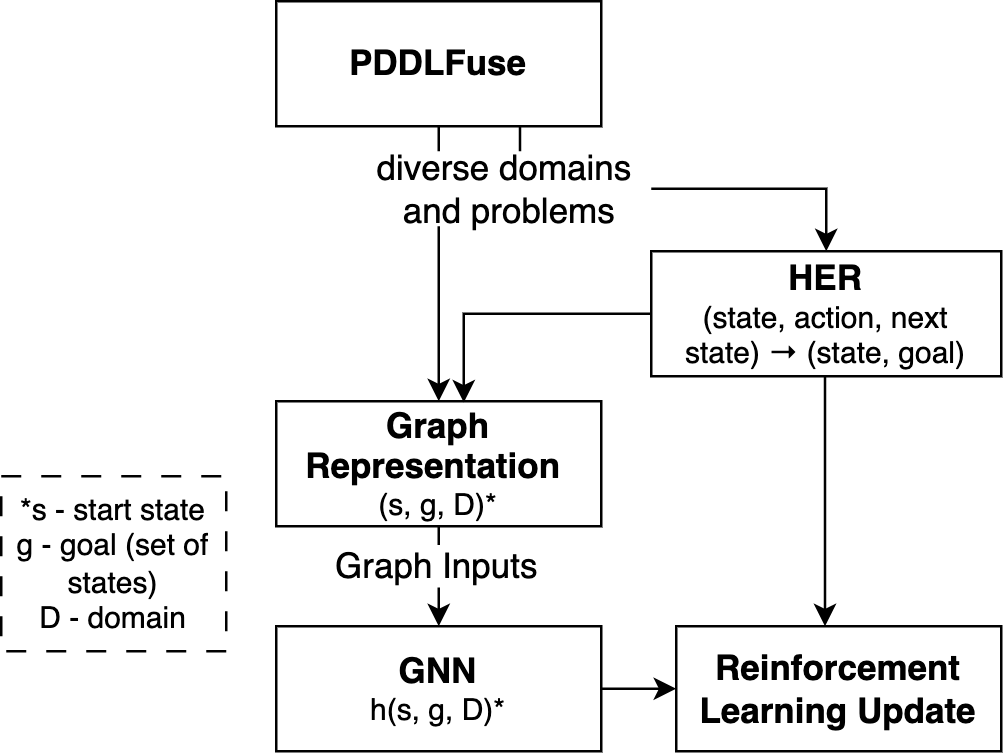
Figure 1 illustrates how diverse domains and goals are converted into graph inputs for heuristic learning.
Key contributions
- Introduces DeepCubeAF, a reinforcement learning based foundation model for heuristic learning in pathfinding.
- Proposes enhanced PDDLFUSE with adaptive negation and planner-aligned action generation to produce solvable and diverse domains.
- Demonstrates improved generalization over supervised GNN heuristics (GOOSE) across eight domains and leave-one-out settings.
- Shows competitive or superior performance to Fast Downward (FF heuristic) on several domains and improved generalization to an unseen domain.
Recommended citation: Vedant Khandelwal, Amit Sheth, and Forest Agostinelli. (2025). "Towards Learning Foundation Models for Heuristic Functions to Solve Pathfinding Problems." GenPlan Workshop, AAAI 2025.
Download Paper | Download Slides