
A Neurosymbolic Fast and Slow Architecture for Graph Coloring
Published in Twelfth Annual Conference on Advances in Cognitive Systems (ACS), 2025
SOFAI-v2 combines fast LLM search with strict metacognitive checking and symbolic fallback to solve fixed-k graph coloring under exact constraint requirements.
Why it matters
- Constraint satisfaction problems require strict constraint adherence, but LLM-only solving is often unreliable on exactness requirements, while symbolic search can be slow.
- This work focuses on graph coloring in fixed-k decision form, where correctness is directly verifiable and supports systematic iterative guidance.
- The fast/slow setup addresses the practical gap between LLM speed and adaptability versus symbolic correctness on hard constraint-heavy instances.
What we did
- Introduced SOFAI-v2, extending SOFAI-v1 with iterative metacognitive governance over a fast solver (S1) and a slow fallback (S2).
- S1 = Mistral-7B proposes candidate colorings; the metacognition module verifies each output with a polynomial-time correctness score based on edge conflicts.
- When incorrect, metacognition generates template-based feedback listing conflicting adjacent vertex pairs, and can add guiding examples with episodic-memory context for the next S1 attempt.
- If no improvement is observed after 5 iterations (or the score remains below threshold), the controller invokes S2 = DSATUR with backtracking.
- Under a strict 200-second per-instance budget, evaluation reports a 10.5% higher success rate and up to 30% faster solving versus a traditional symbolic baseline, on instances up to 50 vertices.
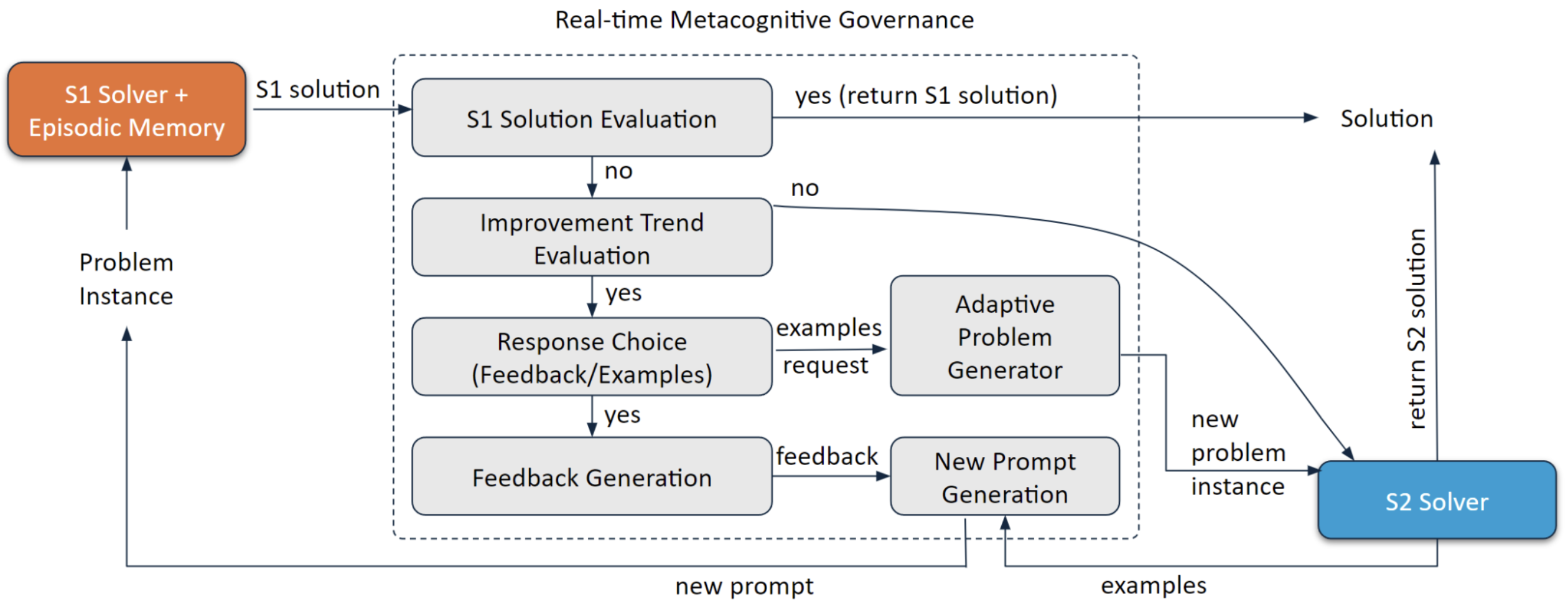
The architecture diagram clarifies how verification and fallback are wired into the loop.
How it works
- S1 proposes a k-coloring (or
NOT SOLVABLE) from a structured DIMACS prompt. - Metacognition computes a constraint-adherence score by checking edge conflicts; only perfect adherence is accepted.
- If incorrect, metacognition generates template feedback listing conflicting adjacent vertex pairs.
- The controller can add simplified subgraph examples and retrieve similar past instances from episodic memory.
- If progress stalls across iterations, metacognition invokes S2 (DSATUR with backtracking) as fallback.
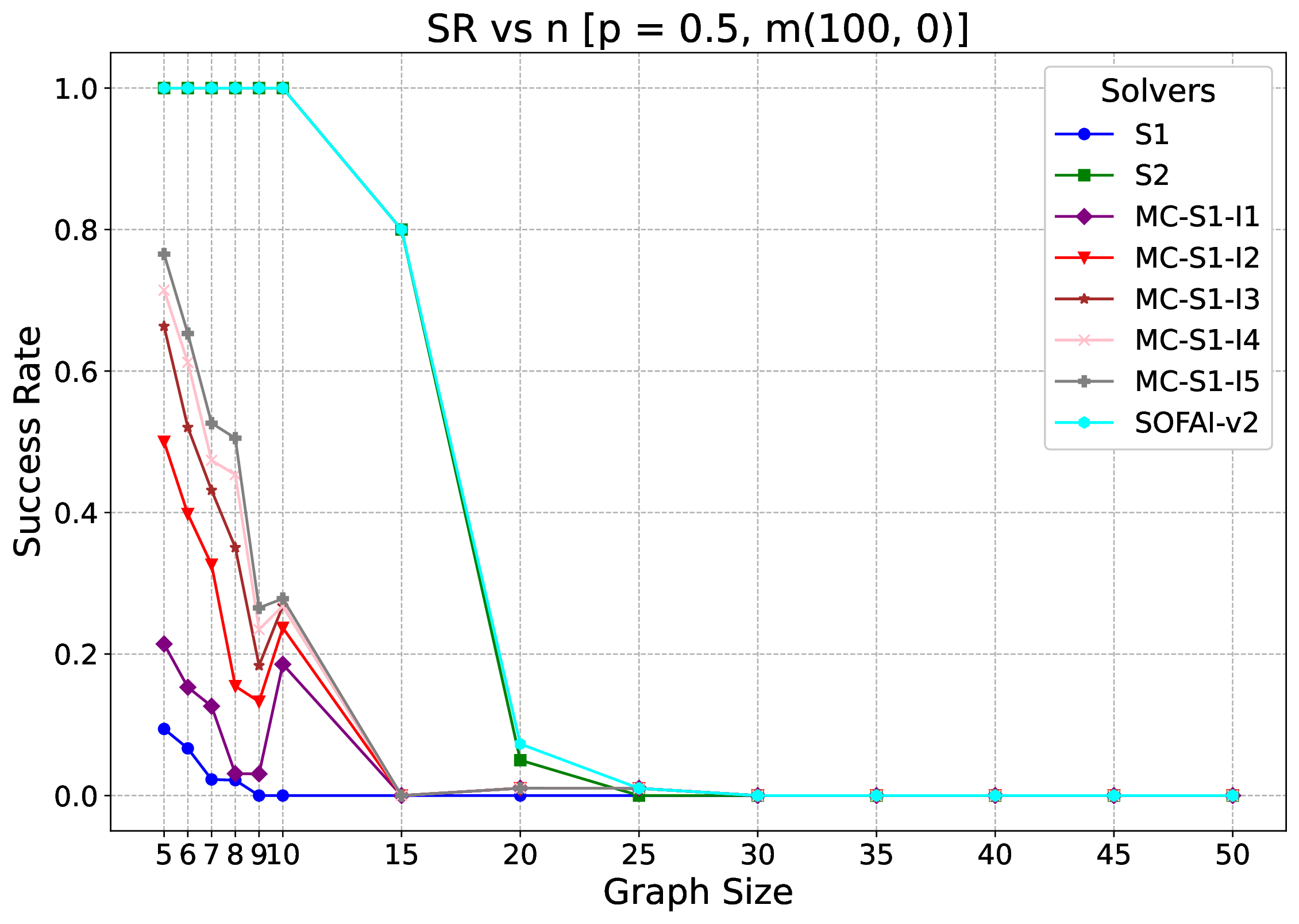
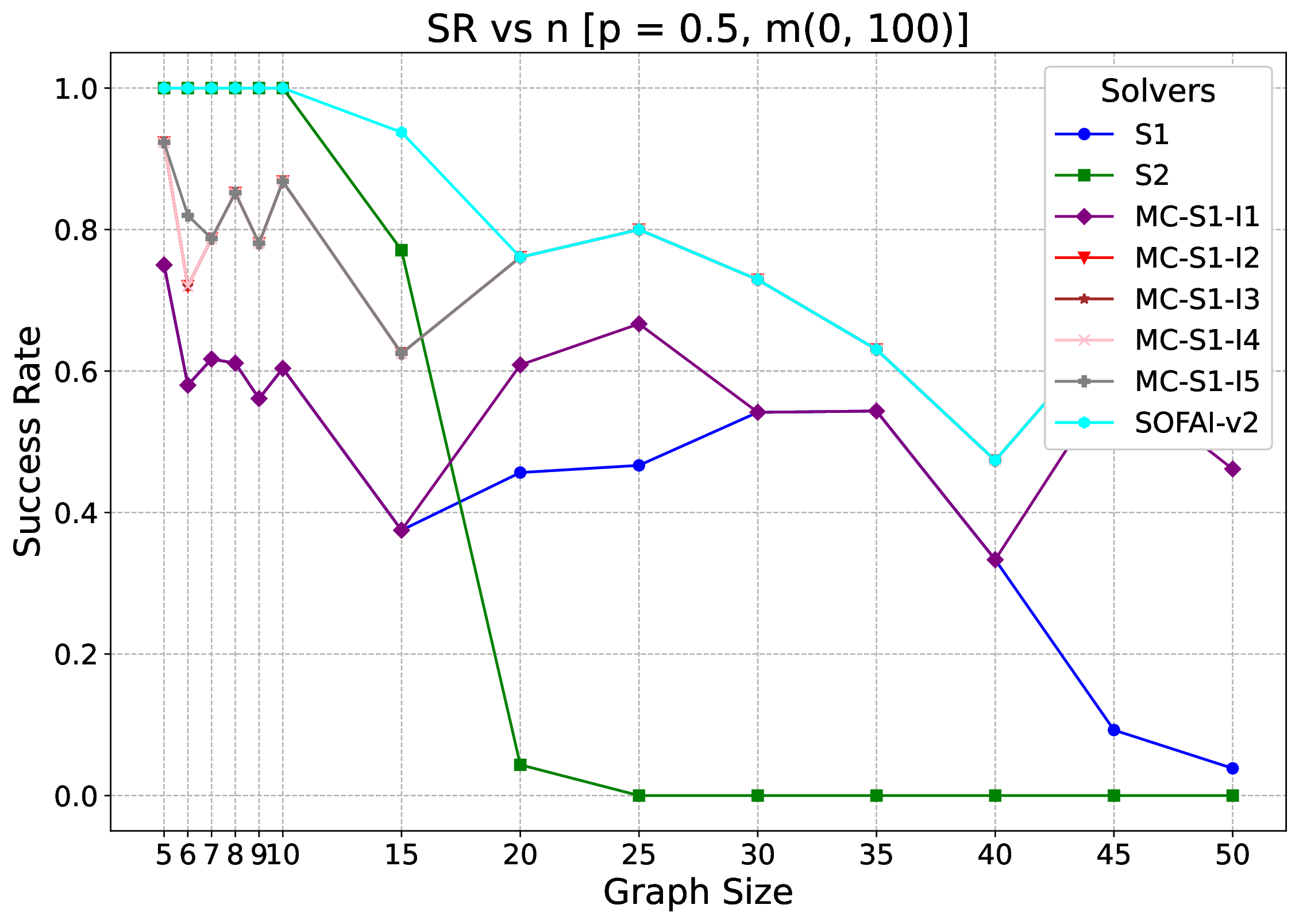
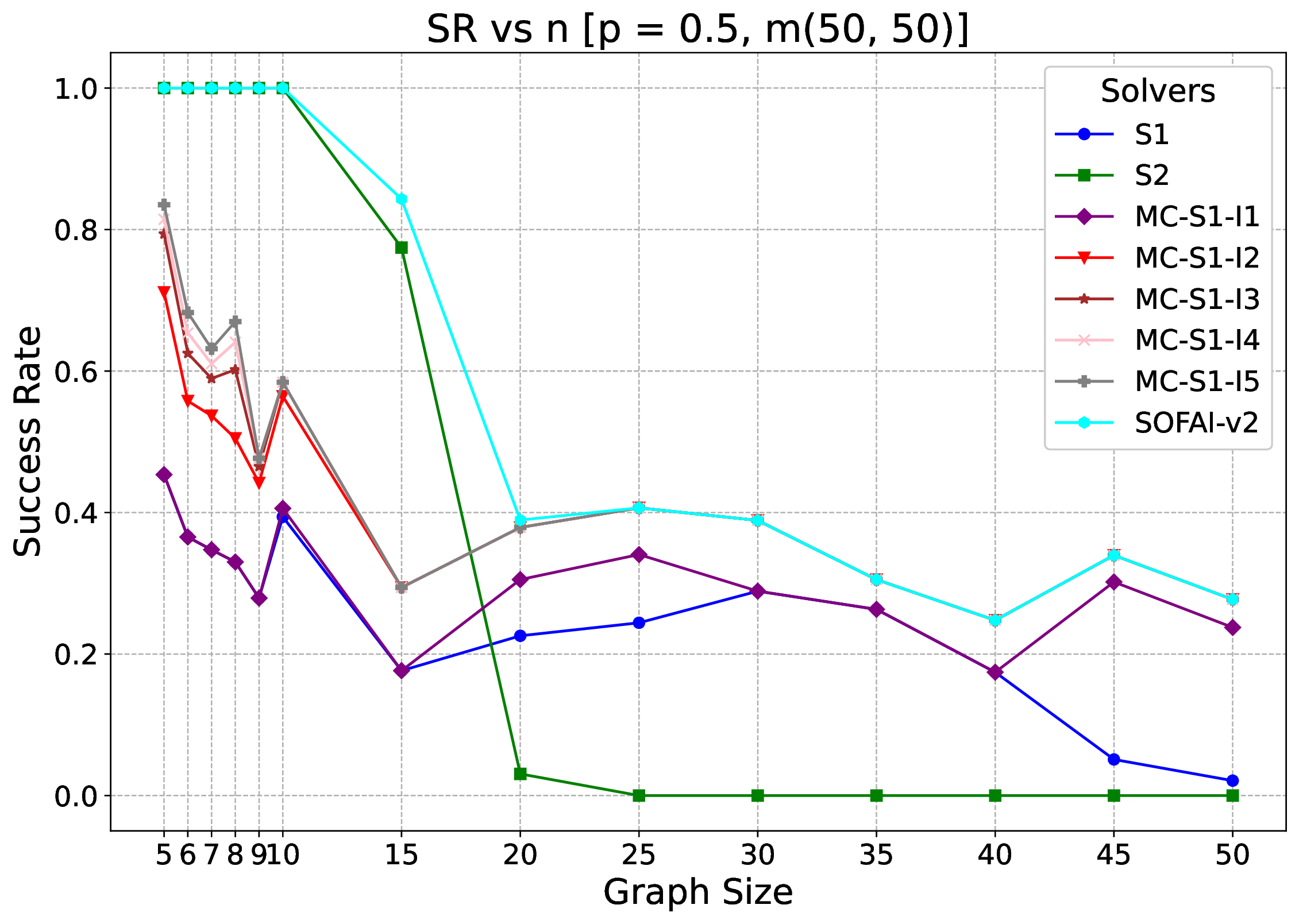
The iteration plot shows why multiple feedback rounds matter, not just a single retry.
Key contributions
- A SOFAI-v2 control loop coupling LLM proposals with polynomial-time verification and feedback.
- An episodic-memory retrieval mechanism to condition S1 with similar solved instances.
- An empirical study showing improved success rate and time efficiency versus S1, S2, and SOFAI-v1 baselines.
- An analysis of how iterative feedback rounds change success behavior across graph-size and solvability regimes.
| Graph Size | m(100,0) [%] | m(0,100) [%] | m(50,50) [%] | |||||||||
|---|---|---|---|---|---|---|---|---|---|---|---|---|
| S1 | S2 | SOFAI-v1 | SOFAI-v2 | S1 | S2 | SOFAI-v1 | SOFAI-v2 | S1 | S2 | SOFAI-v1 | SOFAI-v2 | |
| 5 | 9.41 | 100 | 100 | 100 | 75 | 100 | 100 | 100 | 45.36 | 100 | 100 | 100 |
| 10 | 0 | 100 | 100 | 100 | 60.38 | 100 | 100 | 100 | 39.39 | 100 | 100 | 100 |
| 15 | 0 | 80 | 80 | 80 | 37.50 | 77.08 | 89.58 | 93.75 | 17.65 | 77.45 | 83.33 | 84.31 |
| 20 | 0 | 5 | 5 | 7.29 | 45.65 | 4.35 | 47.83 | 76.09 | 22.58 | 3.06 | 24.73 | 38.95 |
| 30 | 0 | 0 | 0 | 0 | 54.17 | 0 | 62.50 | 72.92 | 28.89 | 0 | 33.71 | 38.89 |
| 40 | 0 | 0 | 0 | 0 | 33.33 | 0 | 47.37 | 47.37 | 17.43 | 0 | 24.55 | 24.77 |
| 50 | 0 | 0 | 0 | 0 | 3.85 | 0 | 3.85 | 53.85 | 2.11 | 0 | 2.11 | 27.72 |
The success-rate table makes the gains most visible on larger, mixed, and unsat-heavy settings.
Recommended citation: Vedant Khandelwal, Vishal Pallagani, Biplav Srivastava, and Francesca Rossi. (2025). "A Neurosymbolic Fast and Slow Architecture for Graph Coloring." Twelfth Annual Conference on Advances in Cognitive Systems (ACS).
Download Paper | Download Slides